12.58pm BST
Aldi and Lidl will be subject to same rules as major supermarkets, CMA says Also on the retail front, Aldi and Lidl will be subject to the same rules as major supermarkets to ensure customers get the best choice of where to shop, the UK’s competition watchdog has said.
The Competition and Markets Authority (CMA) has decided to designate Aldi, Lidl GB and Lidl NI as “large grocery retailers,” a move that will prevent the discount chains from blocking rival supermarkets opening close to their stores.
The UK food and grocery market is worth an estimated £222.7bn, with Aldi and Lidl ranking among the top five retailers by market share, the CMA said. The two German supermarket groups have grown strongly in recent years and opening new stores around the country.
Aldi is the UK’s fourth-largest grocer with a market share of 10.6%, behind Tesco, Sainsbury’s and Asda, while Lidl has been vying for fifth place with Morrisons, at 8.2%, according to retail analysts Wordpanel by Numerator.
The order has applied to Asda , Co‑op , Marks and Spencer , Morrisons , Sainsbury’s , Tesco and Waitrose since 2010. It is designed to stop large grocery retailers from using land agreements to make it harder for rival supermarkets to open nearby – in particular through the use of restrictive covenants and exclusivity arrangements. The rules ensure supermarkets compete freely – and ultimately ensure shoppers have more choice about where to buy, and how much to pay for, their groceries.
In August , the CMA invited views on its proposal to designate Aldi, Lidl GB and Lidl NI under the order. Interested parties including Morrisons, Waitrose and Iceland submitted their views, and all supported the CMA’s proposal. The regulator said it did not receive representations from Aldi or Lidl.
Once a retailer is designated, it cannot include any prohibited restrictions in new agreements – and existing agreements can be reviewed by the CMA, on the request of interested landowners, developers, and rival supermarkets.
Juliette Enser , executive director for competition enforcement and markets at the CMA, said:
We put in place rules to stop big supermarket chains from blocking rival stores opening in their area, and now those rules apply to Aldi and Lidl.
This will help level the playing field and make sure shoppers get the best choice of products and prices in their area.
12.42pm BST
Save high street by taxing online sales at higher rate, Burnham urged Andy Burnham has been urged by one of his most senior former advisers to tax internet sales at a higher rate than those in physical shops to help “level the playing field” for struggling high streets.
As the prime minister and his chancellor, John Healey , prepare for their first budget next week, Andy Haldane joined calls for them to take action to stop the shutters coming down on growing numbers of shops across the UK.
In an interview for a Guardian series looking at how Britain can reverse the declining fortunes of towns, the former Bank of England chief economist urged them to launch a realignment of the tax system away from favouring online sellers, alongside a review of business rates and measures to turbocharge devolution.
Related: Save high street by taxing online sales at higher rate, Burnham urged
12.39pm BST
Meta strikes deal with Zuckerberg to protect him from California wealth tax Meta has struck a deal with Mark Zuckerberg to protect him from the threat of a California wealth tax targeting billionaires.
The social media company behind Facebook, Instagram and WhatsApp revealed on Wednesday night that the arrangement would keep its chief executive living in California , where its headquarters are located.
Under the deal, Zuckerberg will receive new shares that could be sold to potentially foot a multibillion-dollar tax bill in the event that California passes a one-off billionaire tax. In return, he is committed to remain a resident of the state, or wherever Meta maintains its base, for eight years
Californians will vote early next month on Proposition 40 – a one-time 5% tax on the roughly 250 billionaires who live in the state.
Related: Meta strikes deal with Zuckerberg to protect him from California wealth tax
12.35pm BST
Lunchtime summary: French bond yields jump as oil prices hit five-month high Time for a summary.
Investors are demanding a similar risk premium to buy France’s 10-year government bonds against safe-haven German Bunds to 2011 during the eurozone debt crisis.
The spread between bonds of both countries reached more than 173 basis points today, the widest since November 2011, although still below the 200bps seen at the height of the global financial crisis.
The yield, or interest rate, on the benchmark French 10-year government bond is up 11.5bps at 5.1%, after rising as high as 5.1415%, its highest since July 2002. It breached 5% for the first time on Wednesday.
The French 10-year yield also rose above that of the equivalent US Treasury bond for the first time today, as US Treasury yields declined.
Related: French borrowing costs overtake US amid budget turmoil
Giada Giani , an economist at Citi, said:
There exists a consensus that Europe is better equipped today to deal with crises, and that European institutions are stronger today than they were 15 years ago, which should make a European response easier to put together.
But re-emerging euroscepticism is a constrain here.
Bonds are under pressure from rising inflation, with concerns stoked by a jump in oil prices today, as well as worsening government finances and persistent street protests over the cost of living and other grievances in France and Italy.
Oil prices jumped to a five-month high after attacks in Saudi Arabia and hits to tankers in the strait of Hormuz threatened further disruptions to the world’s crude supply.
Brent crude, the international benchmark for oil prices, rose more than 3% above $112 a barrel for the first time since 18 May. It is now trading at $111.85 a barrel, up $3.05 on the day, a 2.8% gain.
Yemeni Houthis , who are aligned with Iran, hit several targets in Saudi Arabia on Wednesday, with two people killed and eight more wounded in a civilian airport in Dammam, and two people killed in a drone attack on a Saudi oilfield.
Spot gold has fallen nearly 2% to $4,063 an ounce.
Related: Oil prices jump to five-month high as attacks threaten global supply
A closely-watched survey showed an improvement in French business confidence in early October, but it did not capture the recent protests, with more planned for Saturday.
A divided French parliament is struggling to pass the annual government budget plan for next year, needed to keep a lid on its ballooning budget deficit and growing public debt pile.
Analysts at Goldman Sachs think the budget wrangling could well last into December, and the annual budget gap could hit 6.4% of GDP. Even if the government can get its €54bn savings package through, the deficit will still amount to 5% plus of GDP for the third consecutive year and push total debt above 120% of GDP for the first time — second only to Italy in the eurozone.
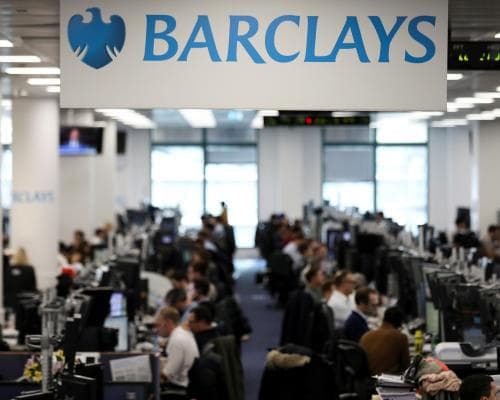
Barclays is cutting 5,000 jobs as part of wider cost-saving plans that its bosses say are being driven by advances in AI.
The job cuts will mean losing about 5% of the bank’s 93,000 global staff, with executives confirming they had already cut 1,000 workers since the start of the year.
The bank’s chief financial officer, Anna Cross , told reporters that the job cuts were part of plans to save more than £1.1bn in 2027.
These actions involve an expected reduction of circa 5,000 full-time employees. Around 60% of the group actions relate to support functions, including fewer developers, as AI makes our people more productive.
Related: Barclays to cut 5,000 jobs as bank’s bosses hail AI productivity advances
Updated at 12.41pm BST
11.42am BST
Maritime and port workers: how is the Middle East conflict affecting you? The conflict in the Middle East continues to disrupt shipping across the region, including in the strait of Hormuz, one of the world’s busiest maritime routes.
Iran state TV has reported that seven oil tankers were damaged in the Straight of Hormuz on Wednesday night. There has been an increase in the number of attacks on ships in recent days; some vessels have been hit by drones, others by mines.
We would like to hear from maritime workers, port staff and shipping crews or families aboard ships affected by the conflict. What is happening in the Strait of Hormuz? How is the situation affecting your work? We would also like to speak to friends or family of those on board. What are you hearing? How are they coping?
Related: Maritime and port workers: how is the Middle East conflict affecting you?
11.16am BST
John Healey says helping entrepreneurs will be a budget priority A week today John Healey , the chancellor, will be doing a media round defending the budget he is presenting on Wednesday next week.
Ahead of that, he has given an interview to Patrick Maguire from the Times. As you would expect, there is no real detail in it about the measures he will be presenting to MPs.
But the big picture message is very clear – and quite surprising, coming from a chancellor serving a PM who in some respects is steering left compared to his predecessor, writes the Guardian’s political correspondent Andrew Sparrow .
Healey says that he wants to be on the side of bloody-minded entrepreneurs who make a profit, he acknowledges that government has made their life harder over the past two years, and he suggests that cutting the ‘cost of living’ for business is just as important as cutting the real cost of living for families.
In the quote that gives the Times its splash headline, Healey says:
I want to be a chancellor who backs business in Britain making a profit, and those entrepreneurs who, in the end, are the ones who challenge the status quo, come up with innovative ideas and are trying, some of them through sheer bloody-mindedness, to keep going through these sorts of pressures …
If you’re not making a profit, you’ve got nothing to put back into the business. And for the people who start up these businesses, the ones who really thrive and grow, they have to make a profit — and they will be much more inclined to put it back into their own business. But we want it to grow here and stay here.
You can follow the latest on our politics live blog with Andrew Sparrow here:
Related: Barclays boss indicates bank taxes in budget ‘bearable’ and backs Healey – UK politics live
10.56am BST
Sainsbury's says households 'finding it tough' in run-up to Christmas Sainsbury’s has warned of a “pretty challenging” market in the run-up to Christmas as households are “finding it tough” and food producers face rising costs.
Simon Roberts , the chief executive of the UK’s second biggest supermarket, called on the government not to “further aggravate” pressure on costs for business in this month’s budget.
He said it was “important this government does not repeat what we have seen in previous budgets” in raising business rates and employers’ national insurance contributions. “That’s been really hard,” he said.
After Sainsbury’s and other industry leaders met government ministers last week, Roberts said he believed “this government is really listening to business” especially on helping to create more jobs for young people.
Roberts added that food inflation was not “anything like” some of the high levels forecast earlier in the year but suggested high energy and fertiliser costs could push up food prices next year.
Roberts added that in a more unsettled global environment the UK needed to “improve food resilience and grow and produce more at home”. He called on the government to increase tax breaks that support investment in technology – including irrigation and reservoirs – on farms as the climate crisis is expected to