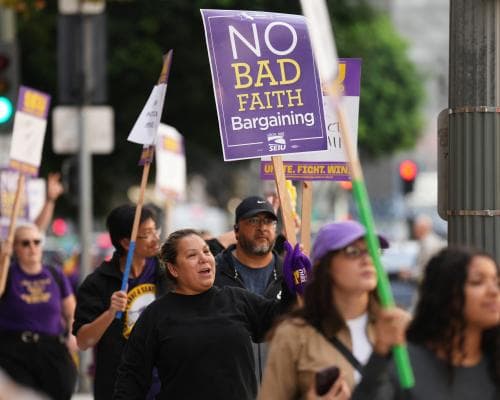
Thousands of California state workers walked off the job Wednesday in a sweeping one-day strike as tensions boiled over lapsed contract negotiations with Governor Gavin Newsom’s administration.
SEIU Local 1000, a union that represents roughly 100,000 public employees, has been at an impasse with the state since its contract expired on 30 June.
Negotiators say state officials rejected their key proposals: a 20% salary increase over three years, higher state healthcare contributions and flexible telework – Newsom has required state workers to be in office four days a week.
Union representatives also argued in a complaint filed with California’s public employment relations board that the state engaged in bad faith bargaining, by allegedly waiting until 30 June to respond to some of the proposals and saying there was “no money” for additional compensation.
In downtown Los Angeles, picketers dressed in purple-and-yellow union shirts circled the exterior of the Ronald Reagan state building under light drizzle.
Some motorists slowed down, beeping their car horns in apparent solidarity.
Joseph Santillan, a motor vehicle records specialist, began working at the Department of Motor Vehicles about nine years ago, when he was earning roughly $17 per hour. “As I got higher up in my seniority, we got our annual raises, but now I’m maxed out,” he said.
Santillan, who lives near West Covina, said he had to move out of an apartment he shared with two roommates because it was too costly.
“I’ve been living at home with Mom again for the past six years,” Santillan said. “It’s kind of sad. I’m 43. I should be on my own. I should be able to support myself.”
William Hernandez, a financial institutions examiner, said he was striking for fair pay and changes to the state’s in-office mandate. For his role, the 26-year-old often commutes from Hollywood to various banks around Los Angeles and southern California without a car.
“I personally don’t have a car because it’s too expensive to afford both a car and housing,” Hernandez said. About half of his monthly wages go to rent.
In the afternoon, David Huerta, president of SEIU-West, drummed up energy, sparking a labor chant: “Sí, se puede!” (Yes, we can!)
“Their fight is representative of the fight right now that’s happening across the state, across this country, as working people continue to get more and more squeezed. And the ability to be able to live becomes more and more difficult,” Huerta said.
Wednesday’s picketing marked a first for the union.
California’s department of human resources (CalHR) had reportedly attempted to block the strike, arguing the union did not have plans to exempt essential workers and thus was compromising public health and safety. The labor board determined a list of about 5,000 workers deemed essential, according to the union, who will report to work during the strike.
“The department remains focused on achieving a fair and responsible agreement and continues to be available at the bargaining table,” a CalHR spokesperson said in a Wednesday statement.