As authoritarian countries such as Russia, China and Iran are more active in engaging in long-arm strategies to silence their critics in the UK, transnational repression is garnering more attention. It is right that the Metropolitan police and other British law enforcement agencies have specific units and mechanisms to counter it. But it takes more than just confronting this long-distance repression to make political dissidents of these authoritarian countries feel safe in the UK, and the UK government is not living up to expectations.
The threat is real. Members of the Hongkonger community have received threats from the Chinese regime – some have had threatening letters, some people were deepfaked into sexual content, some even had families questioned and arrested back home. With the level of this targeting linked to the deterioration of Hong Kong politics, many have utilised the humanitarian pathway enabled by the previous government to relocate.
The British national (overseas) visa route , opened on 31 January 2021, allows Hongkongers to come and stay in the UK. It has already granted more than 230,000 visas. It’s seen as a success: as proof that the British government honours its commitment to those facing political pressure in Hong Kong. But now, with more high-profile critics of the Chinese regime facing obstacles in the UK’s immigration system, more doubt is being cast on whether the current government still takes the commitment seriously.
In May, Chloe Cheung , for whom the Hong Kong authority has issued an arrest warrant with a HK$1m (£100,000) bounty, applied for indefinite leave to remain but the approval was withheld (while her family’s applications were approved). The Home Office asked a victim of political persecution to explain her “criminality”, a term that echoes Beijing’s propensity to characterise political dissent as a crime. It has caused her an enormous amount of stress. Her leave to remain was granted after a public backlash and pressure from parliamentarians.
Finn Lau, who also has a bounty on his head, applied for citizenship in June 2025 and ticked every box. By March this year, the Home Office had spent more than eight months assessing his “good character”, despite a departmental target mandating a decision in 95% of applications within six months. The fear of his activism being counted against him loomed. He eventually had to make the incident public, and the Home Office finally approved his application after a series of public campaigns.
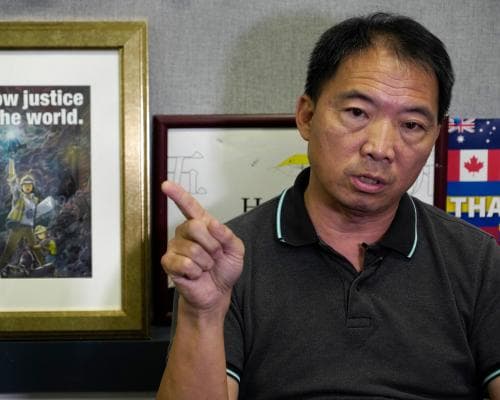
The latest case breaks my heart. Wu Chi-wai, 63, was chair of Hong Kong’s Democratic party and an elected legislator for eight years. He was jailed for more than five years because of his bravery in safeguarding Hong Kong’s freedom and democracy. After serving the jail time, he flew to the UK, where his family has settled. The British consulate in Hong Kong had told him he could apply for the BN(O) visa once he was inside the UK.
At Heathrow, he was refused entry. His passport was confiscated. He was told he would be removed to Hong Kong within seven days . He is in the country now, but only on temporary admission. The Home Office has called it an administrative issue with his paperwork, and has told the media of concerns that it was not a personal visit, but a bid to claim asylum. Only now, after his case became news here and abroad, has his length of stay been extended. He now has permission to remain in the UK with his family for six months.
Where is the humanity here? After years unable to hug his family or hold their hands, Wu’s reunion was halted almost before it began. What would he have done with his family in seven days, after so long a separation? Even asking this question feels cruel.
Related: Jimmy Lai’s sentencing tells me this: democracy is dead in Hong Kong, and I escaped just in time | Nathan Law
Most importantly, Wu had done nothing wrong. He did not enter the country illegally. He did not lie about his intentions. His history of facing political persecution should be seen as a crucial factor in why he decided to come to the UK to visit with his family, rather than seen as evidence that he may not comply with immigration requirements. He is entitled to apply for a BN(O) visa, or travel back to Hong Kong in a few months, depending on his circumstances. In a sensible world, there was no reasonable ground for authorities to reject Wu’s request – they should consider his circumstances and help.
Officials were right to think again, but they also need to reconsider their approach. A sense of security is not achieved only by countering transnational repression. It also comes from legitimately feeling that your host country is actively adopting measures that respect your choices and shield you from unjust political pressure. It is saddening that so many Hongkongers persecuted by the Chinese regime are facing hurdles and blockages from the UK government, exacerbating their already intense anxiety.
Britain made us a promise of humanitarian assistance. This promise should not be compromised because the current government seeks a warmer bilateral relationship with China. Removing all unjustifiable hurdles posed to persecuted Hongkongers is the first step to steer back to the UK’s promise. Britain must take it.
Nathan Law is a pro-democracy activist and former legislator from Hong Kong. He is currently a political refugee in the UK