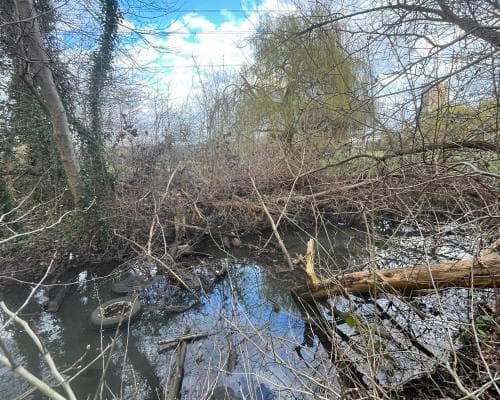
A river campaigner who organised a cleanup of his local waterway is being threatened with prosecution by the Environment Agency for acting illegally.
Paul Powlesland, a lawyer and environmental campaigner, organised a team of volunteers to tackle the removal of litter, weed and silt from a section of the River Roding, after repeatedly asking the agency to act.
The team of volunteers from the River Roding Trust removed 200 bags of rubbish, branches and silt over 10 days from Alders Brook, a tributary of the river that runs through rural Essex and Barking, earlier this year. But the EA has sent Powlesland a letter saying he is being investigated for illegally intervening without a permit.
“We consider that unpermitted works have taken place … in contravention of the Environmental Permitting (England and Wales) Regulations 2016.” read the letter, seen by the Guardian. It added: “The site is currently under investigation for permitting and waste offences.” .
The EA alleges dredging has been carried out and waste has been left on site within the flood plain, constituting a flood risk activity under the regulations that would have required an environmental permit. Carrying out the work without one is an offence, it states.
The agency said it was carrying out additional investigations to see if further relevant information came to light – including whether Powlesland and volunteers had committed other offences and the environmental impact of the offence.
Powlesland, who lives on a boat on the Roding, said he asked the EA to clean up the river several times over many years, but it had not acted.
“After decades of ignoring rampant environmental crime on the Roding, the Environment Agency has finally decided to act,” he said.
“But it’s not action against Thames Water for dumping billions of litres of sewage in the Roding, or the waste criminals who have dumped thousands of tonnes of rubbish on its banks, but against the River Roding Trust for … restoring a river without a permit.”
Organised criminals have been dumping waste illegally along the Roding, where it is falling into a tributary of the river. The EA has been investigating the dumping near Stapleford Tawney, south-east of Epping.
The nature writer Robert Macfarlane, who has visited the Roding, said on Instagram: “If the Environment Agency do prosecute I guarantee they will meet a tidal wave of objection, ridicule and more.”
Since the cleanup in February, Powlesland said: “The section of the river which was cleared is really coming back beautifully, wildlife is returning, yet we are being threatened with prosecution.
“This seems to get to the nub of the problem with the EA. They do not prosecute things that they should prosecute and all they are doing is going after easy targets.”
Powlesland said he would be happy to liaise with the agency and let it know what the charity was planning so the EA could point to any obvious issues such as water mains or rare habitats along the river. “We have asked them repeatedly to do this clearance work. This 10 days was part of our volunteer work over the last five years cleaning up the river, which is the EA’s job,” he said.
The River Roding is subject to significant raw sewage discharges, which the local MP Jas Athwal raised in the Commons this month.
According to data obtained by the Friends of the Roding, the Cran Brook sewage outflow discharges more than 750,000 litres of raw sewage per year into the Roding, information that has been passed to the agency.
In a statement the EA said: “We deeply care about protecting the River Roding and will work with any partners who want to help improve the local environment.
“However, governance and expert advice is necessary to make sure that work does not cause unintended harm – to flood risk, drainage or the wider environment.
“More broadly, we continue to respond to pollution incidents in the River Roding, including working with our partners to rectify pipe misconnections.”
A Thames Water spokesperson said: “Similarly to the outfalls at our sewage treatment works, Combined Sewer Outfalls (CSOs) on the River Roding operate within limits set by the Environment Agency and are a legally permitted process of the wastewater system.
“These discharges are heavily diluted by rainwater, and the system was originally designed this way to prevent sewage from backing up into people’s homes during periods of intense rainfall.
“We take our responsibility to monitor and maintain our wastewater network seriously and understand the concerns raised by Mr Powlesland and the residents of the area.”