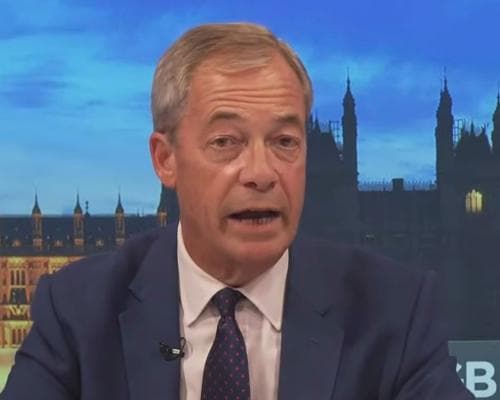
The UK has been confirmed as an outlier in Europe for allowing Nigel Farage and other serving politicians to present TV shows covering current affairs, according to an unprecedented analysis of broadcasting rules.
Farage is one of a series of Reform UK figures who are permitted to present shows on the rightwing network GB News. The Reform MP Lee Anderson and former candidate Matt Goodwin also have regular slots on the channel.
Their status as presenters has led to repeated concerns about the enforcement of Britain’s rules on impartial broadcasting.
Last month, Farage used his first GB News show for six months to defend his party’s decision to accept two record £36m donations from the crypto billionaires Christopher Harborne and Ben Delo.
However, an international study has confirmed that the UK’s decision to allow politicians to present such shows is highly unusual across Europe. In 35 of the 37 European nations studied, regulators found no recent examples of serving politicians presenting news or current affairs programmes. Only Iceland, which has a population of about 400,000 people, and Malta bucked the trend.
In Malta, political parties are even permitted to own television channels. There have been instances where MPs have presented interview programmes, although according to its regulator these are not the norm.
Eight countries – including France, Georgia and Norway – expressly ban politicians from presenting news or current affairs programmes, either through broadcasting legislation or other restrictions.
The practice is constrained indirectly in 26 countries via rules covering impartiality, transparency or independence from government.
Three countries – Armenia, Finland and Malta – had no specific legislation or regulation covering the issue. However, regulators in Armenia and Finland reported no examples of it occurring.
The study, by an academic from the Reuters Institute for the Study of Journalism for the Demos thinktank, will be used as evidence by critics who believe that Ofcom, Britain’s media regulator, has failed to protect impartiality by allowing the politician-led shows.
Ofcom has said that such shows are within broadcasting rules because they are classed as “current affairs” shows by the watchdog, rather than news programmes – a distinction that has been challenged by critics, given the politicians regularly discuss some of the biggest news stories of the day.
The analysis, by the research associate Dr James Painter, found the issue had only caused a serious debate in the UK. “This demonstrates the extent to which the UK is an outlier in Europe with regards to the practice of political presenting news and/or current affairs programmes and the regulatory framework that surrounds it,” the analysis concluded.
Lisa Nandy, the culture secretary, has previously raised concerns about allowing serving politicians to present TV shows and has said she was “exploring action in this space”. However, it remains unclear whether she is considering a change in the law.
GB News has always said Reform politicians are allowed to present current affairs programmes under Ofcom’s rules – a point it has proved in court. Angelos Frangopoulos, its chief executive, has also said its coverage includes a range of political perspectives.
An Ofcom spokesperson said: “Ofcom’s broadcasting code … is clear that no politician may be used as a newsreader, interviewer or reporter in any news programmes unless, exceptionally, it is editorially justified.
“While politicians are permitted to present non-news programmes – provided they are not standing in an election taking place – such programmes must still comply with the other due impartiality rules in the code.
“The code contains rules which Ofcom considers best secure the standards objectives set by parliament – including the special protection afforded to news over non-news content. Changes to the standards objectives are rightly a matter for government and parliament.”
• This article was amended on 16 October 2026. An earlier version in one instance described the analysis as being published by Reuters; in fact, it was by the Demos thinktank as mentioned previously in the article.